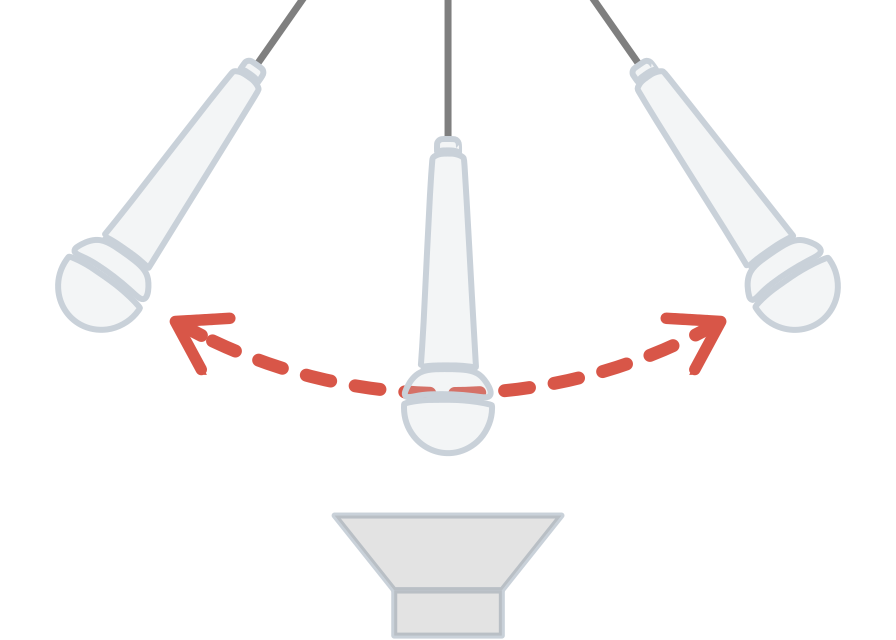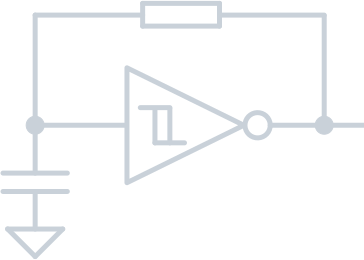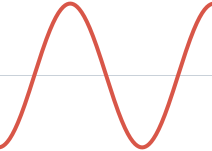
Courses in sound and media art taught at Karlsruhe University of Arts and Design (HfG Karlsruhe). Selected materials are made available below as open educational resources: a complete course (Fundamentals of Sound), excerpts from Sound: Art and Technology, and a teaching repository on GitHub from an international workshop series.
Approach
My teaching is grounded in the aesthetic history of electronic music and sound art and combines lectures with practice-based seminars in DIY electronics and self-built instruments. In an environment increasingly shaped by AI and digital tools, I approach hardware as a haptic and critical counterpart, a way to engage directly with sound, materiality, and the technologies we work with. Historical and theoretical material does not remain abstract: lectures feed directly into hands-on experimentation, often through reconstructing influential works alongside the development of students’ own instruments and performances.
Collaborative work is central to my teaching. Composition, listening, and artistic decision-making emerge through collective experimentation, discussion, and performance. Mistakes and technical instability are treated not as failures, but as opportunities for understanding and critical reflection. I approach listening itself as a pedagogical practice: listening to students, to environments, and to the cultural and technological contexts in which sound is produced. Student independence and the development of sustainable artistic positions remain the most meaningful outcomes of my teaching.
Some slides may not render correctly on Safari/iOS. Use the PDF instead.
Fundamentals of Sound
Physical and perceptual foundation for sound art practice
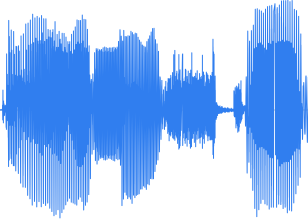
Through listening exercises and short technical experiments, students cover sound waves, timbre and harmonics, hearing and perception, spatial sound, and digital audio, building the theoretical grounding they need for working in practice.
Historical and conceptual foundations of sound art
Students trace the historical context of sound art from Russolo and Cage through musique concrète, sound objects, and acousmatic listening to contemporary installation work by Max Neuhaus, Zimoun, and Ryoji Ikeda, finding a lineage in which to position their own work.
Students rebuild early FM sounds in Max/MSP, from Chowning's Turenas to classic Yamaha DX7 timbres, explore the technique's possibilities, and use it to demonstrate acoustic phenomena like beating and the missing fundamental.
Students engage with soundscape composition, field recording techniques, and acoustic ecology, from Schafer's World Soundscape Project to contemporary ambisonic practice.
Hands-on electronics for experimental sound and live performance
Using CMOS logic chips, breadboard prototyping, and circuit bending, students design and build their own DIY synths, noise generators, and experimental interfaces, and perform with them in a closing concert.